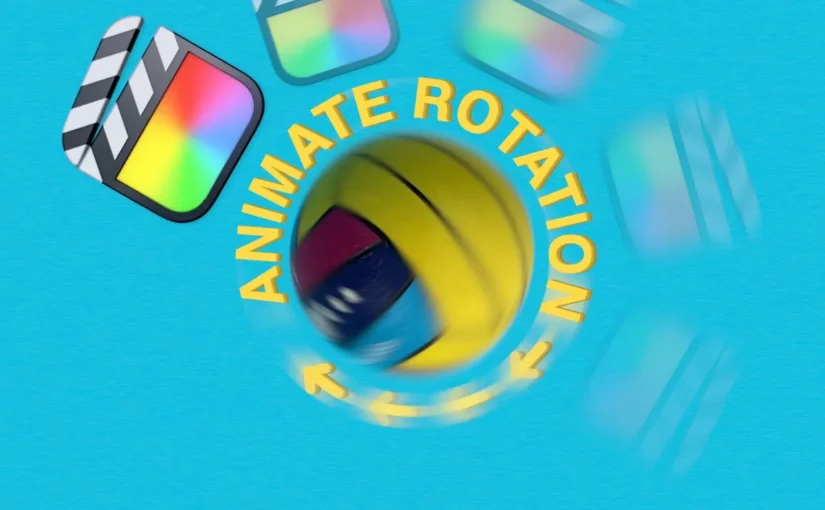
How to Create Smooth Rotation Animations in Final Cut Pro (Using Keyframes)

Final Cut Pro rotation animation is easiest to control when you use keyframes instead of built-in transitions. In this tutorial, you’ll learn how to create a smooth rotation animation in Final Cut Pro using keyframes, giving you precise control over timing, direction, masking, and motion blur.

In this guide, you’ll learn how to create a smooth rotation animation in Final Cut Pro using keyframes, giving you precise control over timing, direction, and where the animation stops.

This technique works for images, logos, graphics, and motion elements — and doesn’t require any plugins.


Why Built-In Final Cut Pro Rotation Animations Are Limited

Final Cut Pro includes rotation and movement transitions that can be applied at the start or end of a clip. While these are quick to use, they come with limitations:

  • You can’t rotate a full 360 degrees
  • You have minimal control over timing
  • The animation always happens at the clip edge
  • Fine adjustments are difficult or impossible

For anything more than a basic effect, keyframe animation is the better option.


Creating a Final Cut Pro Rotation Animation with Keyframes

Keyframes allow you to define exactly how an object changes over time. When animating rotation, this means you can control:

  • How far an object rotates
  • How fast it spins
  • Where the animation starts and stops
  • Whether the motion feels smooth or abrupt

To begin, place your clip on the timeline and open the Video Inspector. Under the Transform settings, you’ll find the rotation parameter.

Add a keyframe at the start of the clip, then move the playhead forward and set a second keyframe where you want the rotation to end. Adjust the rotation value, and Final Cut Pro will animate between those points.

Learn More About Final Cut Pro Keyframe Animation

If you want a deeper understanding of how keyframes work in Final Cut Pro, Apple’s official documentation explains how to animate effects, control timing, and adjust parameters using keyframes.

Find out more: Apple’s official guide to animating effects with keyframes in Final Cut Pro
https://support.apple.com/en-ca/guide/final-cut-pro/ver8e3f20ea/11.2/mac/15.6


Setting the Anchor Point for a Clean Rotation Animation

By default, objects may rotate around an unexpected point. To fix this, adjust the anchor point so it sits in the visual center of your object.

This is especially important for circular objects, logos, or anything meant to spin in place. Even a small anchor point adjustment can dramatically improve how natural the animation looks.


Removing Backgrounds for Rotation Animation in Final Cut Pro

If your object has a visible background, you can isolate it using a shape mask:

  • Apply a shape mask effect
  • Resize and position it around the object
  • Curve the edges to match the shape
  • Reduce feathering for a clean edge

For best results, it often helps to place a solid color behind the object that closely matches the original background. This minimizes edge halos and makes the mask look more natural.


Adding Motion Blur to a Final Cut Pro Rotation Animation

Rotation animations can look unnatural if everything stays perfectly sharp. Adding a subtle radial blur introduces motion blur that makes the movement feel more realistic.

You can keyframe the blur amount so it appears during the rotation and disappears when the object stops moving. This small detail can make a big difference in perceived quality.


Controlling Speed and Timing in Final Cut Pro Rotation Animations

To fine-tune your animation:

  • Move keyframes closer together to speed it up
  • Spread them further apart to slow it down
  • Increase rotation values for faster spins
  • Remove or delete keyframes to stop motion instantly

Viewing the animation controls in the timeline makes it easier to see how changes affect timing.


When to Use This Technique

This rotation animation approach is ideal for:

  • Tutorials and explainer videos
  • Logos and branding elements
  • Motion graphics and intros
  • Educational and instructional content
  • Social media clips

If you want predictable, professional animation in Final Cut Pro, keyframes are essential.


Final Thoughts

Learning how to rotate objects using keyframes in Final Cut Pro unlocks a level of control that basic transitions simply can’t match. Once you understand how anchor points, masks, and motion blur work together, you can create clean, polished animations without relying on third-party tools.

If you’re serious about improving your Final Cut Pro animations, this is a core technique worth mastering.

Want Help Applying This in Your Own Final Cut Pro Projects?

If you want hands-on help applying this Final Cut Pro animation technique to your own projects, I offer one-to-one online Final Cut Pro training. Sessions are flexible, focused on real editing problems, and tailored to your workflow — whether you’re just getting started or refining advanced animation and keyframe techniques.

👉 Find out more: One-to-one Final Cut Pro training
I Used ChatGPT to Edit a Final Cut Pro Tutorial Automatically (XML Workflow Explained)


Can ChatGPT Speed Up Editing in Final Cut Pro?

Editing long tutorials slows creators down. Cutting pauses, tightening explanations, and shaping a usable rough cut often takes longer than recording the video itself. Because of this, I tested a workflow that uses captions, XML, and ChatGPT to speed up editing directly inside Final Cut Pro.

Rather than guessing, I ran the process end to end—and the results were immediately useful.


I Turn Captions into an Editable Timeline

First, I use Final Cut Pro’s built-in caption transcription to convert spoken content into structured text. Instead of starting with blades and timelines, I start with language.

Next, I export the captions as text and send them to ChatGPT with a clear instruction: generate a Final Cut Pro XML file that creates a tight, tutorial-focused edit.

As a result, the edit decisions come from what I actually teach, not from arbitrary cuts.


I Import the AI Edit Back into Final Cut Pro

Then, I import the generated XML back into Final Cut Pro. At this point, I match the timeline resolution to the original media. Otherwise, the XML won’t align correctly.

After importing, I relink the original screen recording. Immediately, the timeline snaps into place with a shortened, structured cut that removes filler and keeps momentum high.

This step alone saves significant editing time.


Where This Workflow Excels—and Where It Doesn’t

This approach does not replace an editor. I still review pacing, clarify explanations, and adjust timing. However, it eliminates the slowest part of the process: building the first rough cut.

More importantly, for tutorial creators and instructors, this workflow consistently turns long recordings into focused edits in minutes rather than hours.


Why I Teach Final Cut Pro This Way

Most Final Cut Pro training focuses on tools. I focus on workflows.

That means I teach creators how to:

  • Edit faster without losing clarity
  • Build repeatable tutorial systems
  • Use AI intentionally, not blindly
  • Work confidently with captions, XML, and structured edits

As a result, my clients spend less time editing and more time creating.


Who This Is For

This workflow works especially well for:

  • Educators recording lectures or demos
  • Course creators building online training
  • Teams producing internal instructional videos
  • Creators who publish tutorials regularly

If that sounds like you, this approach scales.


Final Cut Pro Instruction That Saves Time

Ultimately, AI doesn’t replace judgement—it removes friction. When the trimmed version still works, you’ve already won back hours.

If you want to apply workflows like this to your own projects, I offer focused, practical Final Cut Pro online instruction. I work directly with educators and creators who want faster, cleaner edits using real-world systems—not gimmicks.

Want Help Applying This in Your Own Final Cut Pro Projects?

If you want hands-on help applying this Final Cut Pro animation technique to your own projects, I offer one-to-one online Final Cut Pro training. Sessions are flexible, focused on real editing problems, and tailored to your workflow — whether you’re just getting started or refining advanced animation and keyframe techniques.

👉 Find out more: One-to-one Final Cut Pro training
Create a Workout Video Countdown Timer with Built-in Final Cut Pro Tools

Learn how to make a countdown timer in Final Cut Pro with only the built-in tools. You will develop useful skills about the benefits of working with compound clips in order to manipulate and get the most of Final Cut Pro’s built-in plugins.

Perfect for any exercise video or workout routine content you are creating!

Continue reading Create a Workout Video Countdown Timer with Built-in Final Cut Pro Tools

Final Cut Pro Timeline Shortcuts Quiz

This quiz tests your familiarity with Final Cut Pro shortcuts and features. It covers essential functions such as duplicating clips, copying and pasting attributes, toggling the magnetic timeline, moving clips without changing their position, and grouping clips together. By answering these questions, you can gauge your proficiency in using Final Cut Pro efficiently for video editing tasks.

👉🏼 Take the Timeline Quiz Now

Crafting a Diagonal Split Screen and Adding Animation Effects in Final Cut Pro

Looking to elevate your video editing skills? Dive into this comprehensive tutorial where we explore creating dynamic diagonal split screens in Final Cut Pro. From setting up the timeline to refining masks for precise framing, every step is covered. But why stop there? We’ll also enhance your split screens with captivating animation effects using the BretFX Slide Revealers plugin. Let’s transform your video projects with seamless professionalism.

Continue reading Crafting a Diagonal Split Screen and Adding Animation Effects in Final Cut Pro

Final Cut Pro Tutorial | Stabilize Video Footage

Learn how to stabilize your video footage with Final Cut Pro’s built in tools.

In this video, you’ll learn to wield the powerful stabilization tool within Final Cut Pro. Whether you’re a seasoned editor or just starting your journey, mastering stabilization can vastly improve your footage’s quality. Dive in and explore how to harness its capabilities for both landscape and portrait formats.

If you are looking for next level video stabilisation then check out Topaz Video AI. Video AI stabilization employs advanced algorithms to enhance the steadiness and smoothness of video footage. Whether you choose the tools in Final Cut Pro or advances AI stabilisation there are some cool tools out there that will help you to keep the focus on your subject, not on the camera shake.

Continue reading Final Cut Pro Tutorial | Stabilize Video Footage

Mastering Faster Multicam Video Editing with Final Cut Pro: Key Tips and Tricks

In this tutorial Dylan runs through a range of expert tips and techniques that will help you optimize multicam editing workflows in Final Cut Pro. Whether you are using professional cameras like the Sony Alpha 7S III or shooting on an Apple iPhone this tutorial will give you practical tips you can put into action.

From seamlessly switching camera angles across multiple edits to simplifying clip replacement and fine-tuning audio elements, these tips are designed to streamline the editing process. Additionally, delving into customizing clip names for clarity, pre-building complex scenes with compound clips, and optimizing clip order in the Angle Viewer for intuitive editing will be covered. By implementing these strategies, video editors can expect to significantly enhance efficiency and productivity while mastering multicam editing in Final Cut Pro.

For tips on shooting a multi-cam video project check out Noam Kroll’s guide: How To Shoot & Produce A Multi-Cam Corporate Video Project Or Event

Continue reading Mastering Faster Multicam Video Editing with Final Cut Pro: Key Tips and Tricks